Type something below and watch it turn into strange styles right in front of you. Runes, floating accent marks, and tiny raised letters give you six different looks, all ready to copy in one tap.
Everything happens right here in your browser, with nothing to install and nothing to sign into. Type your text, choose a look that catches your eye, then send it wherever you are posting next.
How to Use This Weird Font Generator?
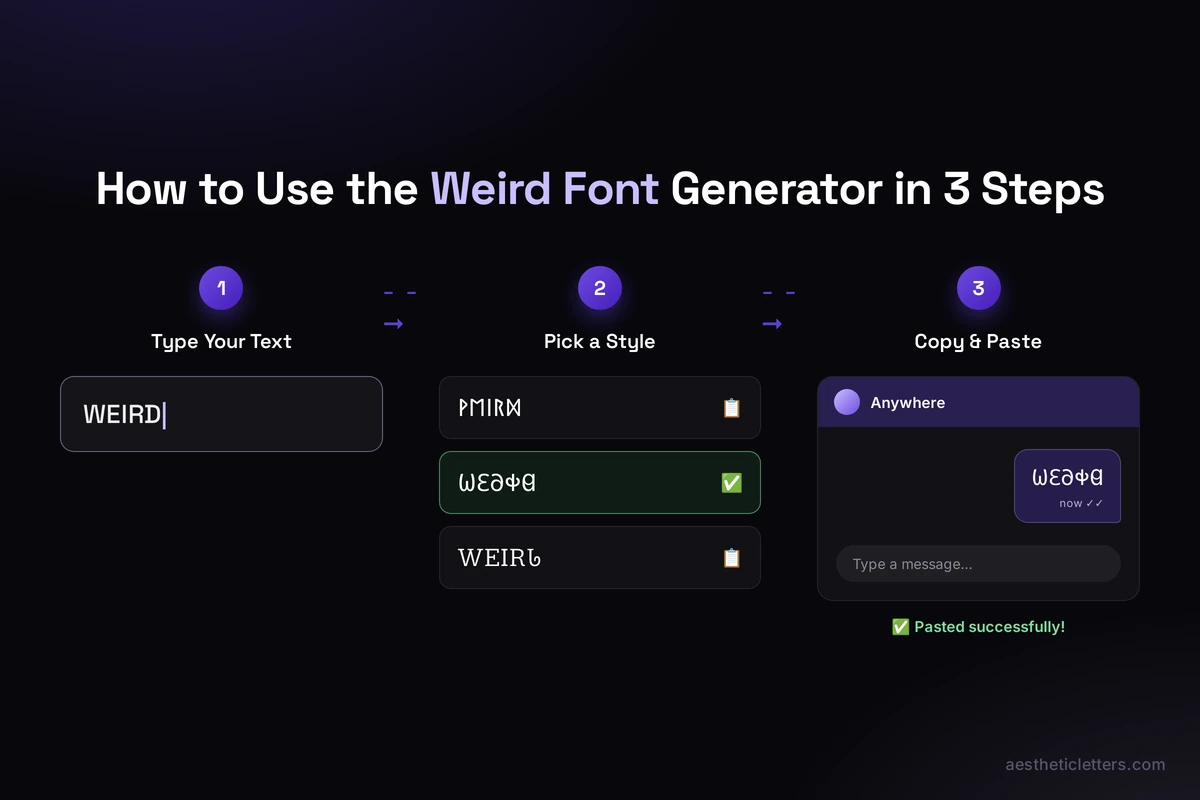
Start typing in the box above the styles. Each one updates as you go, so you can watch your text turn weird in real time and pick whichever version catches your eye. Copy and paste takes one tap once you find a style you like.
Found one you like? Tap it. It copies automatically. Now paste it into your Instagram bio, a Discord message, or wherever you're headed next.
One thing worth knowing: some apps don't play nice with unusual characters. If a style pastes as blank boxes or question marks, that's the app being fussy, not the tool breaking. Try a different field and it will usually work fine.
What Makes These Weird Fonts Work? (Unicode Explanation)
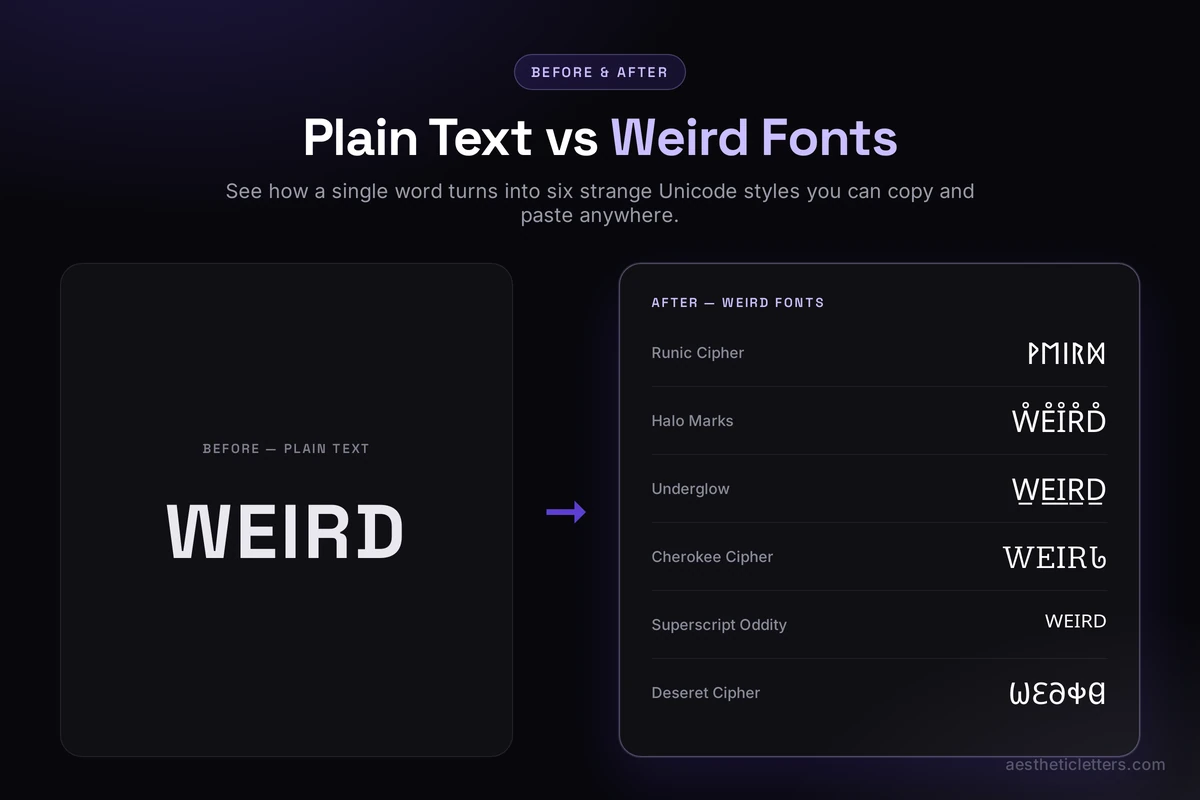
Weird fonts carry a bit of a misleading name. Your phone or computer installs nothing new when you use one. Each style instead borrows characters Unicode already ships with, the same standard quietly running behind every keyboard you have ever typed on.
Unicode is a shared character standard that gives every letter, symbol, and script in the world its own unique code, so any device can display it the same way. It covers everything from the alphabet you're reading now to runes, syllabaries, and accent marks.
Think of it like this. Your keyboard types the letter A. This weird letter generator swaps it for a rune, adds a little ring above it, or shrinks it into a raised symbol. The letter didn't change. Only the character representing it did.
That explains why the text works everywhere without you installing anything. It also explains why a few letters occasionally look normal instead of styled. More on that below.
Weird Font Styles Overview
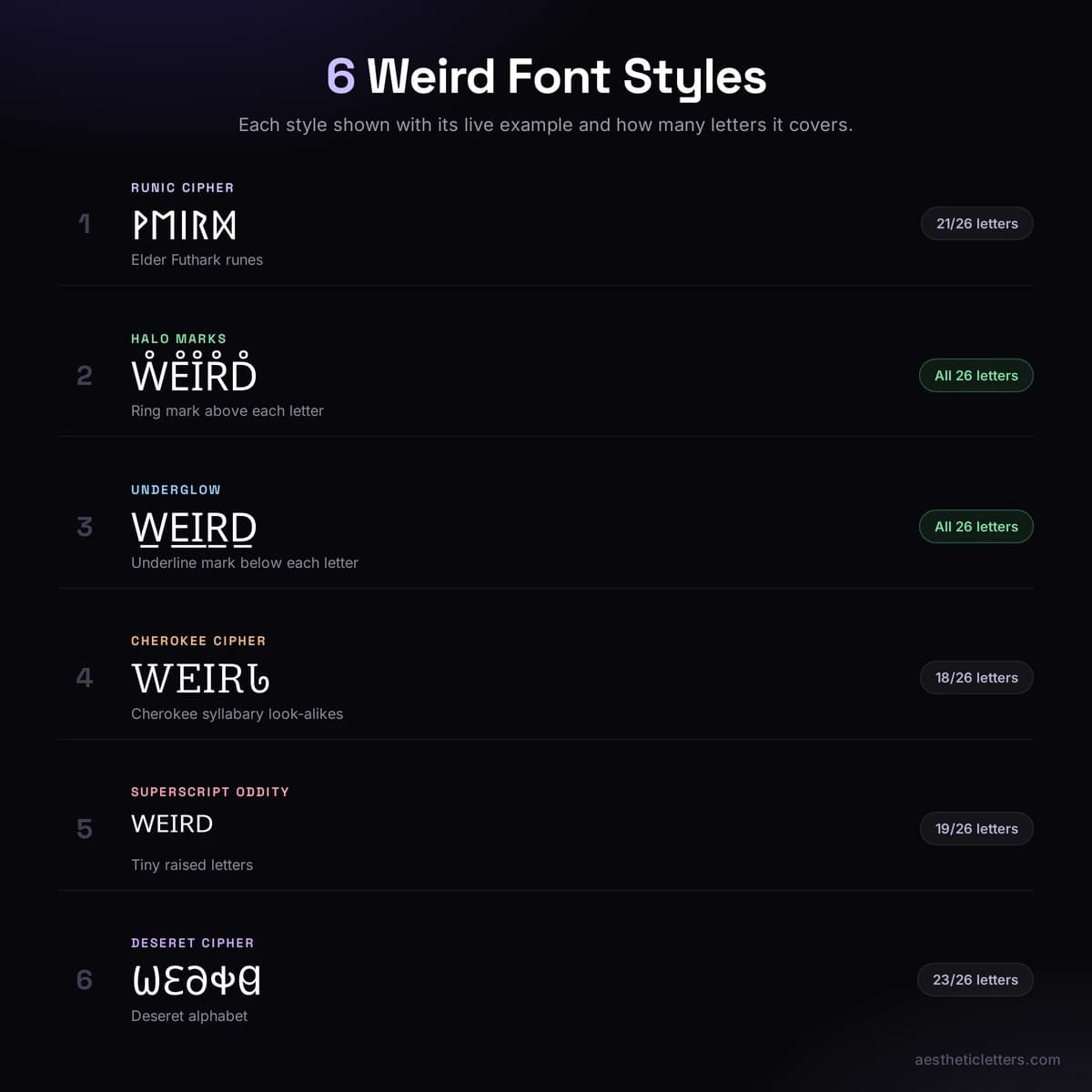
Six styles live on this page. Here's what each one actually looks like before you scroll through them properly.
| Style | The Look | Letters Covered |
|---|
| Runic Cipher | Ancient Germanic runes standing in for your letters | 21 of 26 |
| Halo Marks | A soft ring floating above every letter | All 26 |
| Underglow | A line or dot anchored beneath every letter | All 26 |
| Cherokee Cipher | Characters borrowed from the Cherokee syllabary | 18 of 26 |
| Superscript Oddity | Letters shrunk down and lifted into the air | 19 of 26 |
| Deseret Cipher | Letters from an 1850s phonetic alphabet built for English | 23 of 26 |
A few styles above don't cover all 26 letters. Where a match doesn't exist, that letter just stays normal. Each card below tells you exactly which ones.
Runic Cipher
Your letters turn into runes from the Elder Futhark, a writing system used by Germanic tribes long before the Latin alphabet spread across Europe. It gives your text a carved, ancient look, like something pulled off a stone marker.
Five letters (C, Q, V, X, and Y) don't have a matching rune, so they stay in their regular form when typed. This kind of gap gets the same honest treatment on our christmas font generator, where Fraktur runs into a similar five letter gap.
Example: WEIRD becomes ᚹᛖᛁᚱᛞ
Halo Marks
A single ring floats above every letter you type, giving the whole line a soft glow. Because only one mark repeats across the entire line, your eye never has to work out what a letter looked like before.
All 26 letters carry the mark, so nothing falls back to plain text here. Worth knowing though: since each mark counts as its own character, a five letter word like WEIRD becomes ten characters once styled, roughly doubling your count against any limit.
Our twitter font generator found a similar hidden cost with certain Unicode styles counting double toward X's character limit.
Example: WEIRD becomes W̊E̊I̊R̊D̊
Underglow
Underglow works the same way as Halo Marks, but the mark sits beneath each letter instead of above it. The result feels grounded rather than floaty, almost like each letter has its own shadow line.
Like Halo Marks, this style covers every letter of the alphabet with no exceptions.
Example: WEIRD becomes W̲E̲I̲R̲D̲
Cherokee Cipher
This style borrows characters from the Cherokee syllabary, a writing system Sequoyah completed in 1821 and the Cherokee Nation still uses today. Several of its characters happen to resemble Latin letters, which is what makes this style work as a cipher.
Eight letters (C, F, I, K, N, Q, U, and X) don't have a close visual match, so they display normally instead of being swapped.
Example: WEIRD becomes ᎳᎬIᎡᏓ
Superscript Oddity
Every letter shrinks and lifts, sitting slightly above the line like a tiny footnote mark. It reads almost like whispered text, small and set apart from a normal sentence.
Seven letters (C, F, Q, S, X, Y, and Z) don't have a superscript match yet, so those stay full sized within the styled text. The same superscript block shows up for digits on our Number Font Generator.
Example: WEIRD becomes ᵂᴱᴵᴿᴰ
Deseret Cipher
This one swaps your letters for the Deseret alphabet, a phonetic writing system built in the 1850s to spell English exactly how it sounds. It never replaced ordinary spelling, but the letters live on inside Unicode.
Three letters (C, Q, and X) stay in their normal form. English never gives these letters a sound of their own, since C, Q, and X all borrow sounds already covered by K or S, so the alphabet skipped them entirely.
Example: WEIRD becomes 𐐎𐐁𐐀𐐡𐐔
The Real Scripts Behind Our Weird Text Styles
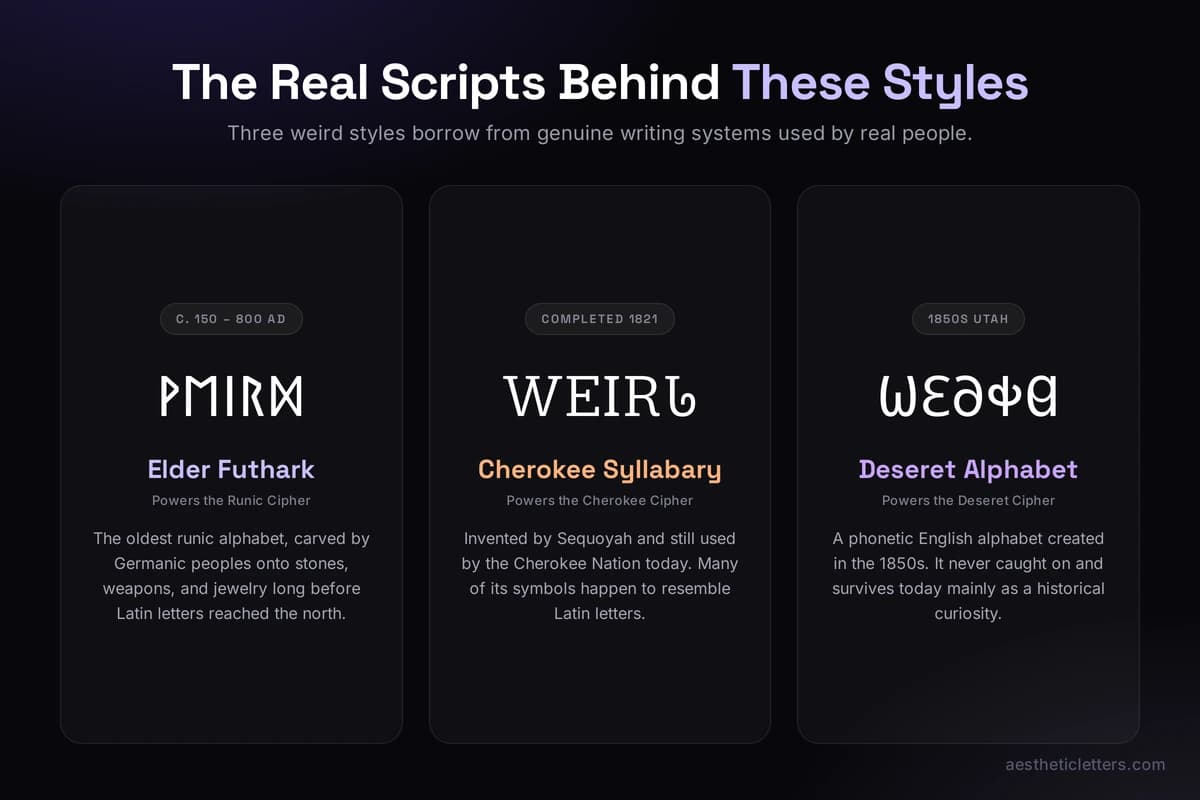
Three of these weird font styles pull from writing systems that existed long before Unicode did, each with its own real history worth knowing.
The Elder Futhark, used for Runic Cipher, dates back roughly 1,700 years. Germanic tribes across Northern Europe carved these runes into stone, wood, and metal long before the Latin alphabet reached the region.
Each rune originally represented a sound, not just a letter. That is part of why some do not map cleanly onto our alphabet today.
Cherokee Cipher borrows from a script with a much more recent story. Sequoyah, a Cherokee silversmith, completed the Cherokee syllabary in 1821, giving his language a written form for the first time.
Some characters were shaped to resemble Latin letters he had seen, though they represent entirely different sounds. The script remains in active use today, taught in schools and printed on official Cherokee Nation documents.
Superscript Oddity works differently. Its characters come from the Unicode block built for phonetic notation, the same kind linguists use to mark stress and pronunciation in dictionaries. Nothing ancient here, just a practical tool borrowed for a playful purpose.
Halo Marks and Underglow don't borrow from any script at all. Both use combining marks, small symbols Unicode allows you to stack onto any letter.
A combining mark attaches to the character right before it rather than standing on its own. Type a letter, add the mark, and your device renders them as one shape. That is why every letter can carry one, unlike Runic or Cherokee, which is why they reach full alphabet coverage while the others don't.
Deseret Cipher tells a stranger story than either. Religious leaders in the Utah Territory commissioned the alphabet during the 1850s, betting that a purely phonetic system would help new settlers learn to read English faster. A handful of books went to print using it.
The experiment barely lasted a decade before ordinary spelling won out completely. Almost nobody reads it today, yet the full alphabet still sits inside Unicode, waiting for anyone curious enough to type it out.
Best Uses for Weird Font Styles
Weird fonts work best where a little personality goes a long way. A bio, a username, or a single line in a caption gets noticed without asking too much of the reader.
Runic Cipher suits usernames and gaming tags well, especially anywhere a bold, ancient feel fits the vibe. Cherokee Cipher carries the same visual punch while telling a small story of its own, worth a mention if someone asks about it.
Deseret Cipher rewards the same curious crowd. Few people will recognize it on sight, which makes it a quiet conversation starter in a bio rather than something loud.
Halo Marks and Underglow read more smoothly across longer stretches of text since they keep every letter recognizable. A short bio line or a quote works better here than a full paragraph, since even readable styles add friction over long text.
Superscript Oddity shines in short bursts too, tucked into a caption or added as a small flourish at the end of a sentence rather than carrying a whole message.
Avoid using any of these styles for anything that needs to stay searchable or easy to copy elsewhere, like a phone number or an email address. The same goes for form fields and usernames on sites that reject unusual characters outright.
Will These Weird Fonts Work Everywhere?
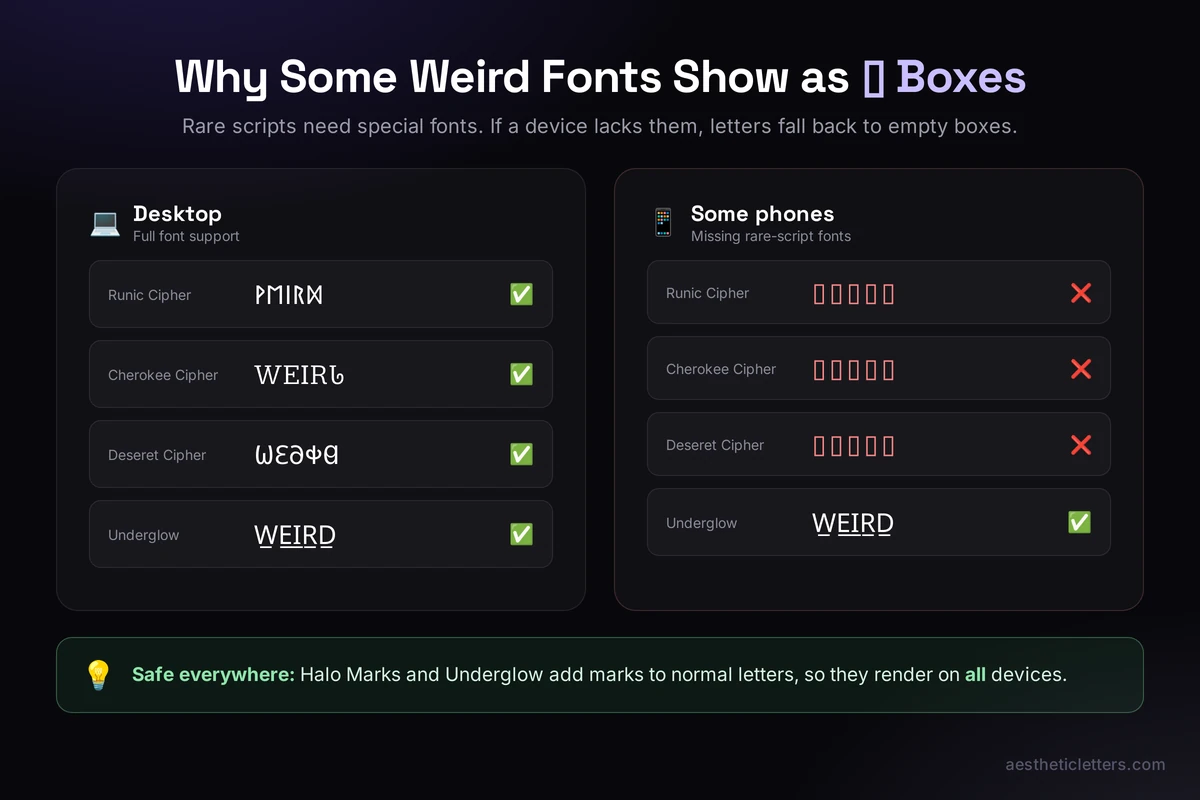
Not quite, and the reasons split into two separate issues worth understanding before you post.
Device Rendering
Runic Cipher, Cherokee Cipher and Deseret Cipher pull from less common Unicode blocks. Most modern phones and browsers display them correctly, but very old devices or apps with limited font support sometimes show a small box instead of the character.
Blame the device here, not the text. Older hardware simply never learned to draw these particular characters. Halo Marks and Underglow rarely run into this, since combining marks are a basic, widely supported part of Unicode.
Platform Acceptance
Some platforms scan for heavily altered text and flag it as spam, particularly in ads or automated messages. Text stacked with many Unicode marks tends to trigger these filters more often than text carrying just one.
Every style on this page uses either a real, limited character set or a single combining mark, never a chaotic stack of marks piled on top of each other. Our facebook font generator found ads get rejected for exactly this kind of heavy stacking.